
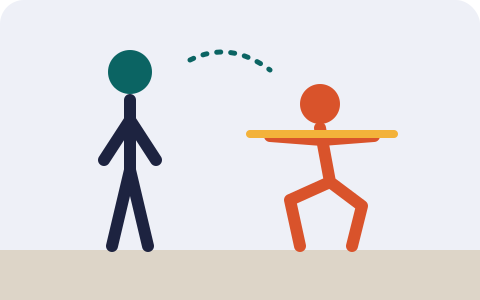
Why technique comes first
Every source behind this site comes back to the same idea: for young people, how an exercise is done matters more than how much weight is on the bar. The American Academy of Pediatrics (AAP) and the National Strength and Conditioning Association (NSCA) both treat qualified instruction and correct technique as conditions for strength training being safe. The National Institute of Arthritis and Musculoskeletal and Skin Diseases (NIAMS) lists incorrect exercise technique among the main risk factors for sports injuries.
Good technique is also how strength actually develops. A movement done well, through a full and controlled range, trains the muscles it is meant to train. A movement done badly with more weight mostly trains the habit of doing it badly.
Learn the movement without load
The AAP's advice to young athletes is to practise every lift without weights first, to make sure form and technique are right, and to add weight slowly only once the technique is mastered. That might mean practising a squat with body weight alone, or learning a pressing movement with a light bar or a broomstick, until the movement looks the same every time.
This stage can feel slow. It is not wasted time. It is where a teen learns to control their own body, which the AAP notes is how much of the early strength gain in young athletes happens anyway: through muscles and nerves learning to work together, rather than through bigger muscles.
The AAP also suggests working all the major muscle groups, including the core, and moving joints through their full range of motion. In practice that means a balanced set of movements, not just the ones that feel impressive.
What good supervision looks like
The AAP links the more serious strength training injuries to unsupervised training, and advises that young people should always train with proper supervision and spotting. Spotting means a trained person standing ready to help if a lift goes wrong, especially with free weights over the body.
Its parent page describes a well-supervised setting as one with an instructor who holds a proper certification and a small number of young people per instructor. It also notes that strength training certifications vary a lot in how demanding they are, so it is reasonable to ask what an instructor's qualification involved.
- The instructor watches each person move and corrects technique, rather than only handing out a sheet.
- Equipment is adjusted to the teen's height and size.
- New movements are taught without load or with very light load first.
- The instructor is comfortable telling a teen to stop, rest or skip an exercise.
- Nobody is pushed to try a maximal lift. The AAP advises against maximal lifts before skeletal maturity.
School teams, school physical education programmes and community facilities can all offer this kind of setting. The guide for parents has a short list of questions to ask.
Worked example (illustrative only)
An invented example. A 14-year-old joins a supervised strength session at a community centre. In the first weeks the instructor has them practise squats, push-ups and a hip hinge with body weight and a light stick, correcting a lot. Only when the instructor is satisfied with a movement is a small weight added. The teen finds this frustrating at first, then notices that the movements feel steadier. This describes no real person or place.
Warming up and the basics of a session
MedlinePlus, the National Library of Medicine's health site, lists warming up and stretching among the basic ways to prevent sports injuries, along with the right shoes and equipment and drinking enough water. It also notes that not warming up enough can lead to injury.
The AAP's strength training advice adds a few specifics that apply to any session:
- Start with a proper warm-up and finish with a cool-down.
- Wear suitable clothing and closed-toe shoes with good grip.
- Breathe steadily through each lift. Holding the breath, bearing down hard or breathing very fast while lifting should be avoided.
- Include aerobic activity in the week as well as strength work.
- Stop lifting at once if there is pain.
Building up gradually
Bodies adapt to training over weeks. NIAMS lists increasing the intensity of activity too quickly, and overtraining, as risk factors for injury. The AAP's advice is to add weight slowly as technique is mastered. The CDC, describing muscle-strengthening activity in general, notes that slowly increasing weight and repetitions over time brings more benefit.
This site deliberately does not suggest specific weights, sets, repetitions or rates of increase. Those depend on the individual, their experience and their sport, and are best set by a qualified instructor who can watch them train. A general rule from the sources is enough here: small steps, and only when the current level is done well.
Habits that raise the risk
Drawing together the AAP, NIAMS and MedlinePlus, these are habits that make injury more likely:
- Lifting alone, or with friends but no trained supervisor.
- Testing the heaviest weight you can lift once, or copying maximal lifts seen online.
- Adding weight before a movement is controlled.
- Training the same movements hard every day with no rest.
- Playing the same sport year-round without a break, which NIAMS lists as a risk factor.
- Carrying on through pain. MedlinePlus is plain about this: if you get hurt, stop, because continuing can cause more harm.
Training at home
Body-weight exercises at home, such as push-ups, squats and planks, can meet the muscle-strengthening part of the activity guidelines and carry little equipment risk. Home weight equipment is different. The AAP's parent page notes that the rare serious accidents in youth strength training include weights falling on a person, which is a particular risk without a spotter.
If a teen wants to use weights at home, the sources point to the same conditions as anywhere else: learn the movements first under qualified supervision, and have a trained adult present. The next guide turns to the parts of strength that happen outside training: food and sleep.